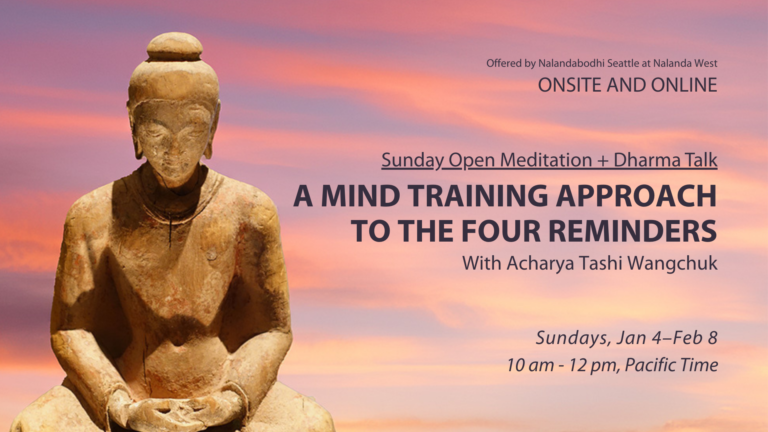
A Mind Training Approach to the Four Reminders with Acharya Tashi
How can we turn our minds towards the path of freedom and kindness? Join Acharya Tashi for a series of dharma talks exploring the four reminders with a mind-training approach.

How can we turn our minds towards the path of freedom and kindness? Join Acharya Tashi for a series of dharma talks exploring the four reminders with a mind-training approach.
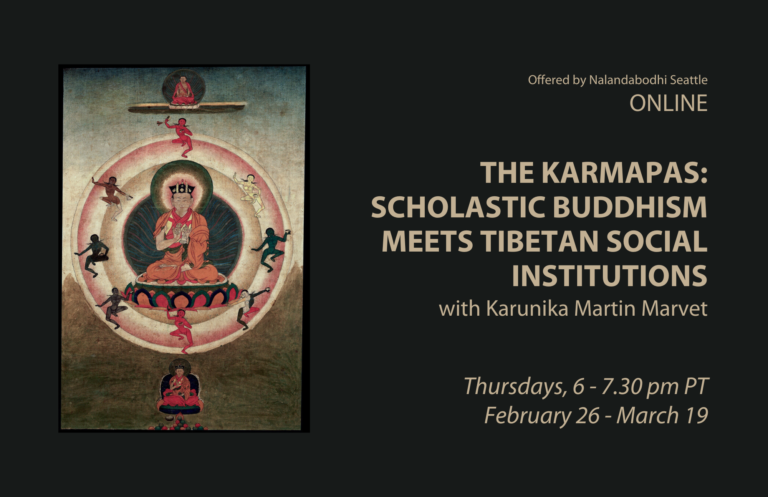
How did the Karmapas develop the Buddhist teachings inherited from India into the Karma Kagyü’s distinctive system of view and meditation? Please join Karunika Martin Marvet in exploring the continuities in the teachings between Karmapas and with the Buddhist traditions of India within the historical panorama of Tibetan society.
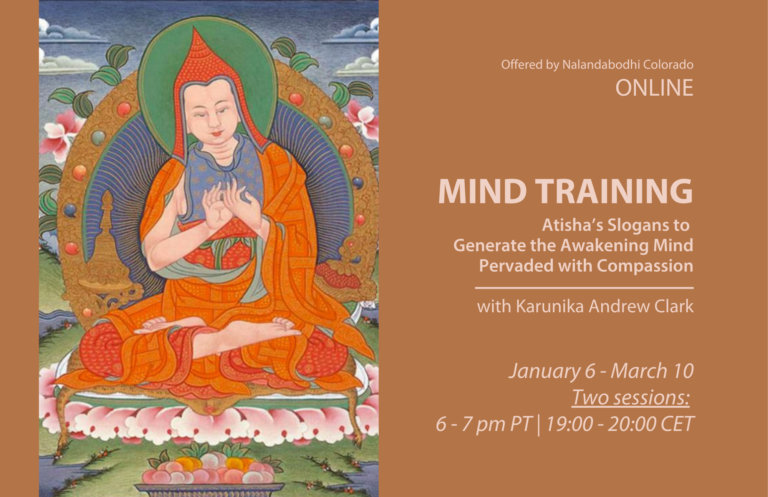
How do we train the mind to benefit all beings? Join Nalandabodhi Colorado in exploring Atisha’s Lojong slogans with Karunika Andrew Clark—practical guidance for this profound practice on our path to freedom.

Inspired by the Kagyü lineage and the lives and teachings of the Karmapas, as well as Ngulchu Tokmé’s classical text, our friends at Karmapa Center 16 offer Sunday Meditation for All with weekly Dharma talks and practice.


In part two, Patricia, Tommy, and Tom, offer reflections on Acharya Lama Tenpa Gyaltsen’s teachings on calming the mind in turbulent times. How to train our minds with patience, kindness, and discipline?

Precious teachings were given by Acharya Lama Tenpa Gyaltsen on Calming the Mind in Turbulent Times. Here is a beautiful first article with reflections and practice suggestions based on this teaching day hosted by Nalandabodhi York.
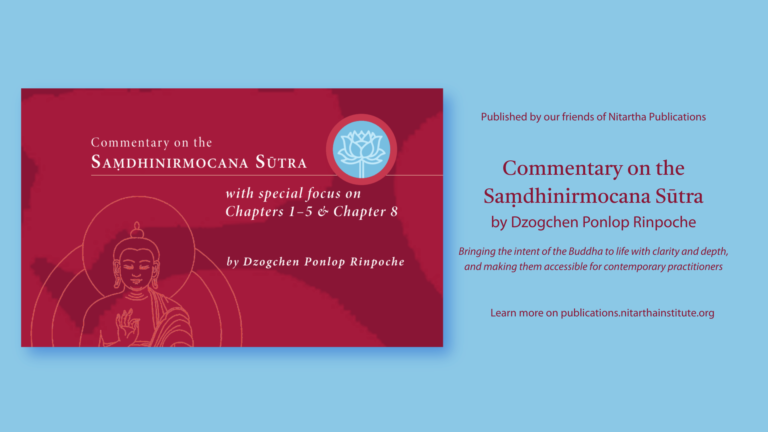
We are delighted to share that our friends at Nitartha Publications have recently released the expanded second edition of Dzogchen Ponlop Rinpoche’s oral commentary on the Saṃdhinirmocana Sūtra (Unraveling the Intent of the Buddha), a key scripture of the Yogācāra tradition.Accompanied by the oral translation of Mitra Tyler Dewar, Rinpoche’s commentary illuminates subtle points of non-dual awareness, conceptual analysis, and direct realization—bringing them to life with clarity and depth, and making them accessible for contemporary practitioners.
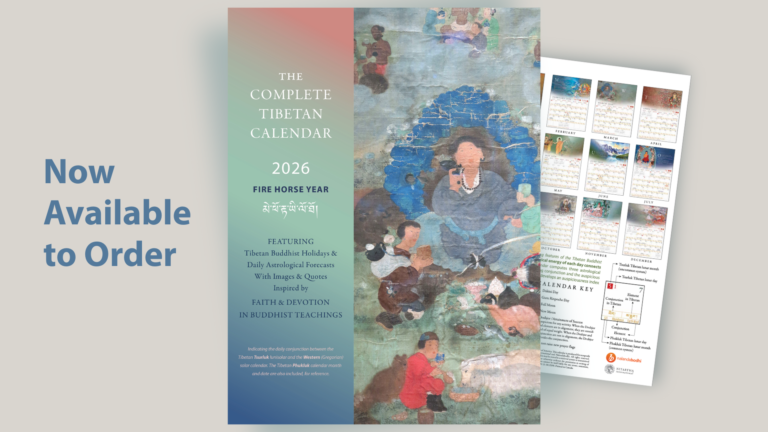
The 2026 Complete Tibetan Calendar is now available! This year of the Fire Horse features inspiring images and quotes on Faith & Devotion in Buddhist teachings, while preserving the rare Kagyu Tsurluk lunisolar astrological system.
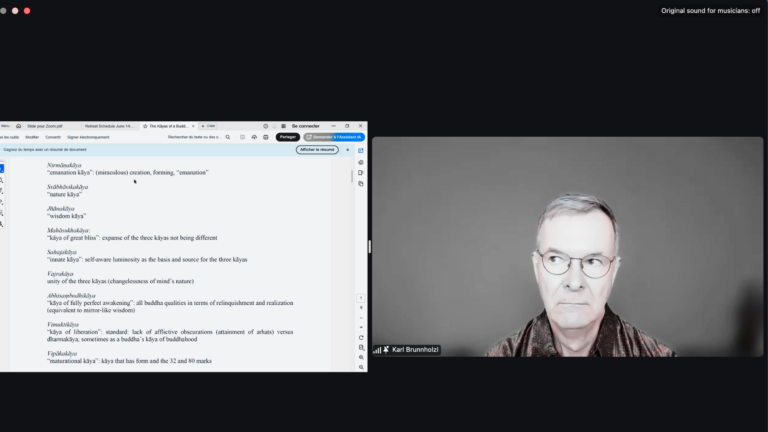
We often hear references to the three or more kāyas of the Buddha, but what are they and where are they? Hosted by Nalandabodhi Montréal, Mitra Karl Brunnhölzl taught an inspiring weekend workshop exploring the universe of the kāyas as presented in the Sūtrayāna and Mahayana traditions, as well as in the Vajrayana texts.

From July 4th to 10th, monastics and lay practitioners gathered together with Dzogchen Ponlop Rinpoche at Tek Chok Ling Nunnery in Kathmandu to commemorate the first parinirvāṇa anniversary of Venerable Khenpo Tsültrim Gyamtso Rinpoche.



“We are made of the love and kindness that other people have selflessly given us, and other beings benefit from the love and kindness we provide them,” writes sangha member Justin Hellier.

Sangha member Alicja Bardin writes from Poland: “I have often thought about people I know but don’t have daily contact with. We are connected, interconnected by circumstances, places, other people . . . After all, being connected is not the same as being in constant touch.”

Mitra Lee writes, “Usually we focus on ourselves, on our own well-being, our goodness or badness, and our perceptions of pleasure and pain, right and wrong, like or dislike. In the practice of the four immeasurables, we train to extend our attention beyond ourselves and our habitual, conditioned thoughts. They help us to open a place for others in our mind and, beyond this, to see others as the same as ourselves.”

在我严重摔倒并遭受创伤后的几个月里,我很难保持清醒。. . .虽然我知道对过去和未来的思索是徒劳的,但如何放下这些思索,时刻保持当下的状态,对我来说是一项挑战。

我们能从鼓励我们暂停的事件或问题中学到什么?我对我们所有人的希望是,我们不会抵制出现的挑战,而是将其视为机遇。我希望我们欢迎这些障碍、这些停顿、这些反思的时刻。同时,让我们对自己和周围的人充满爱心。

我很容易陷入自怜。当我经历身体或情感上的痛苦时,我会发现自己紧紧抓住牢固的自我意识不放。但是,当我运用在长期佛教修行中学到的知识时,我就能放下自我执着和自怜,体验到对包括我自己在内的所有受苦众生的慈悲。

纳兰达数字佛法是在大乘朋洛仁波切的指导下开发的全新在线学习途径,我们很高兴为您提供佛教入门课程。您可以随时随地按照自己的节奏学习。

我们怎样才能像演奏乐器一样愉悦地训练心灵?安德烈亚斯-福斯达尔(Andreas Fosdal)与您分享双簧管、佛教之路以及如何将更多的爱带入我们的世界。


我们怎样才能感受到我们的相互关联性并付诸行动?斯蒂芬妮-米科拉伊(Stephanie Mikolaj)表达了我们如何能够并需要在相互关联的世界社区中相互赋权。

"囚犯应该和我们任何人一样,拥有同样的机会"--尊胜庞洛仁波切。心灵无国界是纳兰达菩提的监狱佛法项目,通过函授课程、佛法笔友和修行导师提供佛法学习。这是一种直接利益他人的方式,让和谐与幸福在我们紧密相连的世界中蓬勃发展。


