Connecting the Disconnected: The Four Immeasurables
Part II
We are honored to share two articles based on Mitra Lee’s teaching at Sangha Retreat 2025. In this second piece, she offers insight and practices for three immeasurables: love, compassion, and sympathetic joy. For part I, which includes background on the four immeasurables and suggested practices for equanimity, see here.
What do we mean by disconnection? Generally, the answer seems to be that we are feeling isolated, lonely, unheard, or misunderstood. But it might be that we feel disconnected from ourself, our feelings, or our purpose. Maybe our spark has gone out.
To address this feeling of separation, we can ask, “What do we want to connect with?
The four immeasurables are already part of our mind’s natural state. We do not have to create them anew. Our practice is simply to progressively clarify and reveal them. We must let go of our self-cherishing, our dualistic grasping and fixation, which inhibit mind’s clarity.
As Chögyam Trungpa Rinpoche taught, the four immeasurables cause disarray in the central headquarters of ego by reversing ego’s logic. This disturbs our ego so that mind’s natural state, or buddha nature, where the four immeasurables exist in their pure form, can shine forth through the cracks.
Usually we focus on ourselves, on our own well-being, our goodness or badness, and our perceptions of pleasure and pain, right and wrong, like or dislike. In the practice of the four immeasurables, we train to extend our attention beyond ourselves and our habitual, conditioned thoughts. They help us to open a place for others in our mind and, beyond this, to see others as the same as ourselves.
In the previous article, I offered contemplations for equanimity, following our lineage’s tradition of working with that immeasurable first. Here, we contemplate the other three immeasurables, which can be practiced in any order. You might feel it preferable to begin with compassion rather than love, for example. But here, we will meditate on love next.
Love
Love focuses on beings who aren’t happy. Loving kindness is like the love of a mother for her child, wanting it always to be comfortable and safe.
It is said that all sentient beings want happiness. Nobody wants to be unhappy. You want to be happy, as do I. Take some time to contemplate your desire to be happy. Next, think how wonderful it would be if every being could have all the happiness and comfort they wanted. Meditate on that until you want others to be happy just as intensely as you want to be happy yourself. Wouldn’t it be marvelous if everyone could be as happy as you would like to be?
Contemplation 1
~ Visualize someone you care about, but not extremely. Not a lover or a child, but a middle sort of caring, like for a friend. Practice sending the same feelings toward them as those you feel toward someone you care for deeply. Can you send unconditional love?
~ Next, visualize someone for whom you have no feeling, someone you are indifferent toward, and practice sending loving feelings toward them just as you do toward those you cherish most.
~ Now visualize someone you mildly dislike and practice sending positive feelings toward them just as you do toward those you love most. You can also do this practice by focusing on a group of people toward whom you feel distaste. Keep practicing until you are able to feel love without exception.
~ Finally, consider someone you really dislike and train in feeling the same positive way toward them. Remember that this is a practice. If you find it impossible to send boundless love to someone you really dislike or who has harmed you, that is not a problem. Aspire to feel differently in the future about them, but be gentle and offer loving kindness to yourself.
~ Recite either silently or aloud: “May all sentient beings enjoy happiness and the root of happiness.”
In The Words of My Perfect Teacher, Patrul Rinpoche’s image for boundless love is of a mother bird taking care of her babies:
She starts by making a soft, comfortable nest. She shelters them with her wings, keeping them warm. She is always gentle with them and she protects them until they can fly away. Like that mother bird, learn to be kind in thought, word and deed to all beings in the three worlds.
Compassion
Compassion is the wish that beings be free of suffering and its causes. We naturally feel caring, especially for those we love. But boundless or immeasurable compassion is caring on a much broader or deeper level, and for most of us this doesn’t come easily or quickly. We shouldn’t feel disappointed, however, when we realize we’re initially limited in our ability to free all beings from suffering. Instead, we can take some time to think deeply about the nature of our own suffering and its causes, and if we can honestly reflect on what freedom from suffering might mean for us personally, we are on the right track to increasing our compassion toward others.
Going beyond the wish—actually working on freeing sentient beings from their suffering—becomes much simpler and more genuine when we recognize how much our own suffering has come about from our selfishness, our self-clinging. The conflicting emotions and karmic actions that have bound us get in the way of being compassionate—even to ourselves! Letting go of our sense of separateness opens our hearts to others.
Contemplation 2
To meditate on compassion, Patrul Rinpoche suggests the image of a mother with no arms, whose child is being swept away by a river. Her love for her child is deep and unconditional, but she has no arms, so she cannot catch him. “What can I do? What can I do?” she wails. Her heart breaking, she runs along after him, weeping.
This is how intensely we should contemplate compassion. However unbearable the compassion we feel, we have no means of saving all the beings of the three worlds, who are being carried away by the river of suffering to drown in the ocean of samsara. When you are confronted with suffering, ask yourself sincerely, “What can I do?” and then call on your teacher and the three jewels from the very depths of your heart, seeking their guidance and wisdom.
~ To start your meditation on compassion, first focus—one at a time—on individuals you know who are suffering. Ask yourself, “Why is this person suffering?” “How can I help?” At this stage, you’re not doing anything in a literal sense, but you must have confidence that your compassion is having an effect.
~ Alternatively, you could imagine a tragic scenario: a deer hit on the highway by a speeding car or a starving child in Palestine. Put yourself in the position of the one being harmed, or imagine they are your child or parent. Allow your compassion to become intense.
~ If you are able to think in terms of many lifetimes, consider that although the being experiencing such suffering is not actually your mother or child in this lifetime, they have been your mother or child countless times throughout innumerable lives.
~ Recite either silently or aloud: “May all sentient beings be free from suffering and the root of suffering.”
Again and again, practice cultivating compassion until you feel exactly the same compassion for all sentient beings as you do for the people you love. Train step by step, being very specific, until you can truly feel compassion for all beings, even those labeled “the enemy.” Otherwise, your feelings will be vague or theoretical, or they will be more like pity and not the real thing.
Sympathetic Joy
The fourth immeasurable concerns those who already have happiness and its causes. The intention of this practice is to overcome jealousy or envy, so our wish is that they never be without happiness and its root. To experience sympathetic joy is to have a mind free of jealousy.
When we see someone who is wealthy and powerful or who enjoys all of life’s pleasures, or when we meet someone who is very knowledgeable about the dharma, or who is beautiful and charismatic, instead of feeling resentful or envious of them, we should have the goal of feeling joyful. We should rejoice in their pleasant circumstances, and make the wish that their riches and power increase even further. Then, we should pray that all sentient beings experience the same kinds of good fortune.
Contemplation 3
Patrul Rinpoche’s image for boundless sympathetic joy is a mother camel finding her lost baby. If a mother camel loses her calf, her sorrow is intense. But when she finds it again, her joy knows no bounds.
~ Think about someone you care a lot about and imagine them being showered with everything good: health, joy, riches. Feel happy for them. Think, “Until they attain enlightenment, may they always be accompanied by happiness and well-being.”
~ Next, try to cultivate the same feeling toward those about whom you feel indifferent. Wish them unlimited joy, abundance, and happiness.
~ Finally, focus on those who may have harmed you or on people you feel jealous of. Try to cultivate the same feeling of happiness for them. Rejoice in their good fortune.
~ Recite either silently or aloud: “May all sentient beings not be separated from the great happiness devoid of suffering.”
~ Conclude by resting in a state of spaciousness without any conceptualization.
An Interconnected Path
You’ve probably noticed that there is a lot of overlap among the contemplations we’ve been practicing. That is because the four immeasurables work together to create a “kind heart,” as Patrul Rinpoche says. For example, attachment might arise when we are generating love. Therefore, we meditate on compassion to counteract that problem. Sentimentality could arise when we contemplate compassion, and equanimity is helpful to counteract that. In this way, the immeasurables work together to create a natural balance. The summarizing verse can be recited again and again:
May all sentient beings enjoy happiness and the root of happiness.
May they be free from suffering and the root of suffering.
May they not be separated from the great happiness devoid of suffering.
May they dwell in the great equanimity free from passion, aggression, and prejudice.
Train yourself to have a kind heart always and in all situations.
I’ll end with a quote by the fourteenth-century Tibetan master Longchen Rabjam (Longchenpa) from Finding Rest in the Nature of the Mind:
Therefore, love, compassion, joy, impartiality
Are of unbounded excellence, and highly praised
By the unequaled Teacher of both gods and humankind.
Any path that lacks them is mistaken,
They err who have recourse to other teachers.
Embraced by the four boundless attitudes,
The path leads on to spotless liberation.
It is the way that all the buddhas tread,
Earlier and later, past, present and to come.

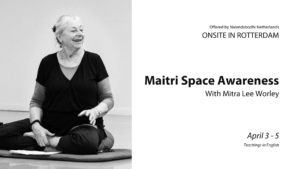
Mitra Lee Worley, professor emerita and a founding faculty member of Naropa University, became a student of Chögyam Trungpa Rinpoche in 1974. At Naropa, she developed the undergraduate program in theater studies and co-created a low-residency master’s program in contemplative education, among many other initiatives over four decades. Mitra Lee earned a master’s degree in Buddhist studies/Tibetan language through Naropa, and in 2005, Dzogchen Ponlop Rinpoche appointed her as one of Nalandabodhi’s four senior western teachers, known as mitras (from the Sanskrit word kalyanamitra, which means “spiritual friend”). Her two books, Coming from Nothing: The Sacred Art of Acting and Teaching Presence: Field Notes for Players, present topics and exercises from her contemplative performance and embodied teaching techniques. Mitra Lee currently studies and teaches within Nalandabodhi International, and she also offers workshops based on the Space Awareness teachings of Chogyam Trungpa, which she has been practicing since 1975.