Upaya
The Secret Sauce of the Dharma
Upaya is a Sanskrit word meaning “skillful means.” We can boil it down to working with two things: methods that work with the realative truth and methods that work with the ultimate truth. Tips and tricks. Cheat codes, if you will. The secret ingredients in our grandmother’s pancakes that give them extra deliciousness. These skillful means speed up our journey on the path.
As I thought about this topic, I recalled eight upayas from various talks and teachings. This is not an official list, but maybe some of these will be useful.
The Guru
The first and ultimate upaya that comes to mind is finding a guru and receiving the lineage instructions. The guru is the key to all upayas and all progress on the path.
Taking Refuge
The second upaya is taking refuge, especially taking refuge in the inner objects through relying on the outer objects of refuge. By relying on the Buddha—the outer teacher—we find our own mind’s nature, the inner buddha. By relying on the outer dharma—the instructions and meditation techniques—we find the inner dharma, our own mind’s wisdom. And by relying on the outer sangha—the community of friends who remind us to be disciplined, diligent, and kind, as opposed to desirous, lazy, and angry—we find our inner mindfulness or recollection, which keeps us from engaging in negative habits.
The power of the upaya of taking refuge cannot be overstated. Simply by shifting our attention inward, we will see a huge shift away from any samsaric habits we have. Looking inward and seeking our own mind will speed up the path and also immediately relieve a huge chunk of our suffering.
Instead of looking outside, blaming others, trying to fix others, or fixating on negative thoughts and appearances, we simply recall the three jewels. We look toward our own mind for refuge. We seek relief in the joyous adventure of finding the mind.
Subtle Impermanence
The third upaya that jumps to my mind is subtle impermanence. Working with this moment, right now, not thinking that we have to practice for a long time. Whenever I think that practice is difficult, it is usually because I have forgotten subtle impermanence. Practicing for one moment is not difficult. It is the concept of a “long time” that makes the path seem difficult.
We may have a concept that “it” will take a long time or a concept that “meditation results need to last a long time.” There is some kind of clinging to the idea of a long time. We can let go of the thoughts of the three times and reconnect with subtle impermanence, which is momentariness.
Resting in the present moment is easy and pleasant. Spinning in thoughts about the three times is the real difficulty. In other words, the thought that “practice is difficult” only arises when we forget to practice. If we analyze, what is really difficult is not practicing.
Bodhicitta
The fourth upaya consists of the two types of bodhicitta: ultimate and relative. Within relative bodhicitta, there are aspiration bodhicitta and application bodhicitta. Within application bodhicitta, the first five of the six paramitas (generosity, discipline, patience, diligence, and meditative concentration) are upayas, and the sixth paramita is prajna (wisdom).
The Vajrayana
All the methods of the vajrayana path make up the fifth upaya. Devotion. The creation and completion stages. Dzogchen and mahamudra. If we are vajrayana practitioners, to study, reflect, and meditate using those methods are practices of engaging upaya.
One key skillful method of the vajrayana is to keep our practice secret. Maintaining secrecy about our vajrayana path speeds up the path. If we keep our meditation practices and our meditation experiences secret, the results of the path will come swiftly.
Life as Dharma Path
The sixth upaya that comes to mind is that this life, this moment, is our dharma path. Instead of creating a separation between our life and our path, we can see our life and our path as the same. We are not practicing something foreign. Rather, we are living the dharma. Our life and the dharma, or this moment and the dharma, are the same thing.
If we are aware of the dharma in this moment, then we have a dharmic life. There is no need to conceptually create a war between our bad, samsaric, confused habits and our good, virtuous, nirvanic habits. If we do so, there will be winners and losers. We will be alternating between good and bad habits.
This mind now is the dharma we have been looking for. Practicing the dharma means working with present appearances. Working with this mind now. Working with our thoughts now, be they bad thoughts or good thoughts. Mixing this moment’s experience with the dharma. Applying the dharma to this present mind now.
Meditation
The seventh upaya is very important. If we don’t meditate, then no matter how much effort we expend on the path, the results will not come. Even if we have studied a lot, even if we have a lot of intellectual understanding, which is very good, if we do not meditate, if we do not put the teachings into practice, nothing will happen at a practical level. What we really need, every day, is to get to the cushion and try. “Erring and erring, I walk the unerring path” as our precious guru Khenpo Tsültrim Gyamtso Rinpoche always said.
Meditating is also how we avoid burnout. If we do not meditate there is a very high likelihood of burnout, but if we meditate and relax often, there will not be burnout.
Relaxation and Humor
The final upaya in this unofficial list is relaxation during formal practice sessions and humor in postmeditation. If we can relax fully while meditating and maintain our sense of humor between sessions, the path will be traversed quickly and easily.
Contemplative Exercise
- Sit on a cushion or in a chair. Take an upright yet relaxed physical posture. Generally, if you get back pain, refrain from stretching forward. Instead, lean backward and stretch from time to time. If you have knee pain, make sure you are sitting with the majority of the body’s weight on the buttocks, not the legs. Sit back farther.
- Take note of your state of mind. Is it agitated? dull? or just fine? If agitated, emphasize relaxation and not moving the body. Lower the eye gaze. Simply sit without moving. The first things to move are usually the eyes or the hands. So, do not move them. If your mind is dull, intensify your body, bring some energy to it, and look upward with wide and intense eyes.
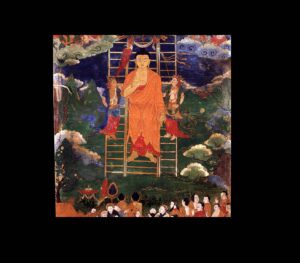
- Simply place the mind on an object in the present moment. It can be any focal object of shamatha that you enjoy. You can focus on your breathing, for example. Or you can visualize Buddha Shakyamuni in the sky in front of you. Imagine the Buddha is sitting in front of you, teaching you the dharma. Smiling. Happy to see you.
- Relax fully. Let go of being so serious. Relax more. Relax as much as you can.
- Your mind may get a sudden urge to move your body. You may want to go to the kitchen to look in the refrigerator, even though you’re not hungry. You may want to text a friend. Strong sudden urges like these are usually a sign that your mind is just about to relax. Just give it a few more minutes. If you keep sitting, if you don’t give in to this urge, the mind will relax momentarily. Let go, and the mind will rest.
- When another thought arises—and it will—relax again. Each thought is like someone throwing a stone into a pond. A few ripples will arise, but if we relax, the ripples will naturally cease again.
- Don’t try to prolong the resting nor fight the mind’s movement. Don’t try to make anything last a long time. Movement of the mind is natural. Just relax and simply return to the focal object.

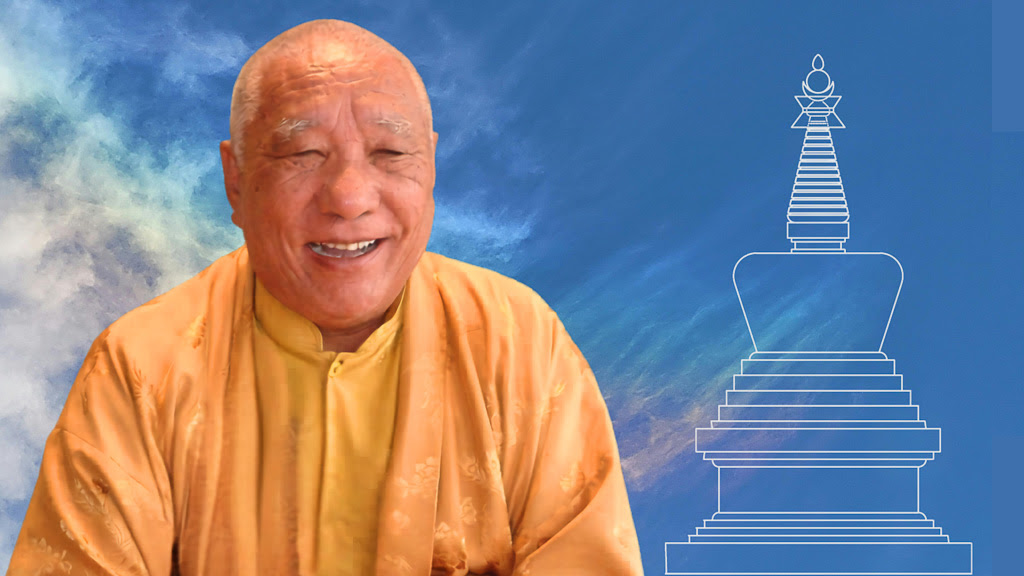
Christian Scott has been a student of Dzogchen Ponlop Rinpoche since 2011. Having grown up among the Khenpo Tsültrim Gyamtso Rinpoche sangha, Christian finds himself humming Milarepa´s Songs of Realization regularly. Since 2012, he has been traveling around the world learning Tibetan as well as studying and meditating on the dharma.