Mandalas as Skillful Means
Healing from Grief Using Co-Created Art
The word mandala in Sanskrit means “circle,” a representation of the unity and the infinite nature of the universe. The sacred geometric symbol is often used as a physical aid in meditation and spiritual transformation. For me as an artist, the mandala is also a versatile visual medium to get everyone to see a bird’s-eye view of a situation and to teach about impermanence and interdependence.
Since 2012, I have created dozens of mandalas, ranging in size from two and a half feet to twelve feet in diameter. They are created from hundreds of little items that are store-bought or handmade by me or the participants in various events. Preschoolers, high-schoolers, people from the community, seniors, friends, sangha members, and fellow artists have contributed to the art-making activities. Whether it’s to tell the story of a person, a historical event, or a neighborhood, or whether it’s to help a community come to terms with changes, the processes of working together and sharing stories have a transformative effect on both the participants and the audience.
Grief Is Universal
Several of my mandalas honor those who have passed and help those who are grieving. For example, I organized the construction of a mandala called Open Heart at Orgyen Dorje Den for TLC Transitional Life Care, a group I have been part of for many years. TLC’s presentations by Buddhist lamas, medical practitioners, hospice workers, and other caregivers range from practical advice to profound spiritual guidance on the process of dying. In 2018, I was asked by the director, Julie Rogers, to conduct a hands-on mandala workshop that would help people heal from the loss of family members and friends.
The Open Heart mandala was inspired by the Buddhist parable of the mustard seed, which tells the story of Kisa Gotami, whose beloved son died at an early age. Refusing to accept his death, this grieving mother carries her lifeless child through the village, asking for medicine for him. Finally, someone tells her to talk to the Buddha, and she begs him for a cure. The Buddha says he can help her—but only if she can bring him a mustard seed from a home untouched by death. Kisa easily finds mustard seeds at each house, but every family has experienced the death of a loved one. Gradually, she comes to realize that her loss is not unique; death is universal to us all. She surrenders her son’s body and asks the Buddha to help her achieve the peace she seeks.
The Open Heart Mandala
My usual mandalas take months to create, but we had only four hours to actualize the six-foot mandala at the temple. I created the middle artwork at home and prepared some items before the day of the workshop. I also asked those who were participating to bring objects to honor their loved ones. I began the session by introducing the mandala concept and explained the significance of the pieces in the middle: thangkas of deities, handmade stupa tsa tsas, the eight auspicious Buddhist symbols, origami lotuses, prayer flags, and mantras.
After my talk, the participants (about half of the fifty attendees) created their own pieces for the mandala. I provided cards for them to write to their loved ones who had died and origami baskets in which to place the special objects and offerings that connected them to their deceased. While they were busy creating their artwork, my assistants and I lit seventy-two tea lights. Placed in the golden origami lotus holders that I had made for them, they were now ready to be added to the mandala at the end. There was also a row of photos that honored other people in the community who had passed, and a row of paper boats carrying the names of other deceased loved ones—given to me by people who couldn’t attend the workshop.
Healing Together
After the art activities were done and the mementos were placed in the mandala, I asked everyone in the room to come up, one by one, take a tea light, say the name of someone who had passed, and hand the candle to my assistant, who placed it around the edge of the mandala. We kept going until everyone had named a deceased loved one and the candles filled the perimeter. We then circumambulated the mandala and looked at all the items people had brought and made, contemplating and remembering.
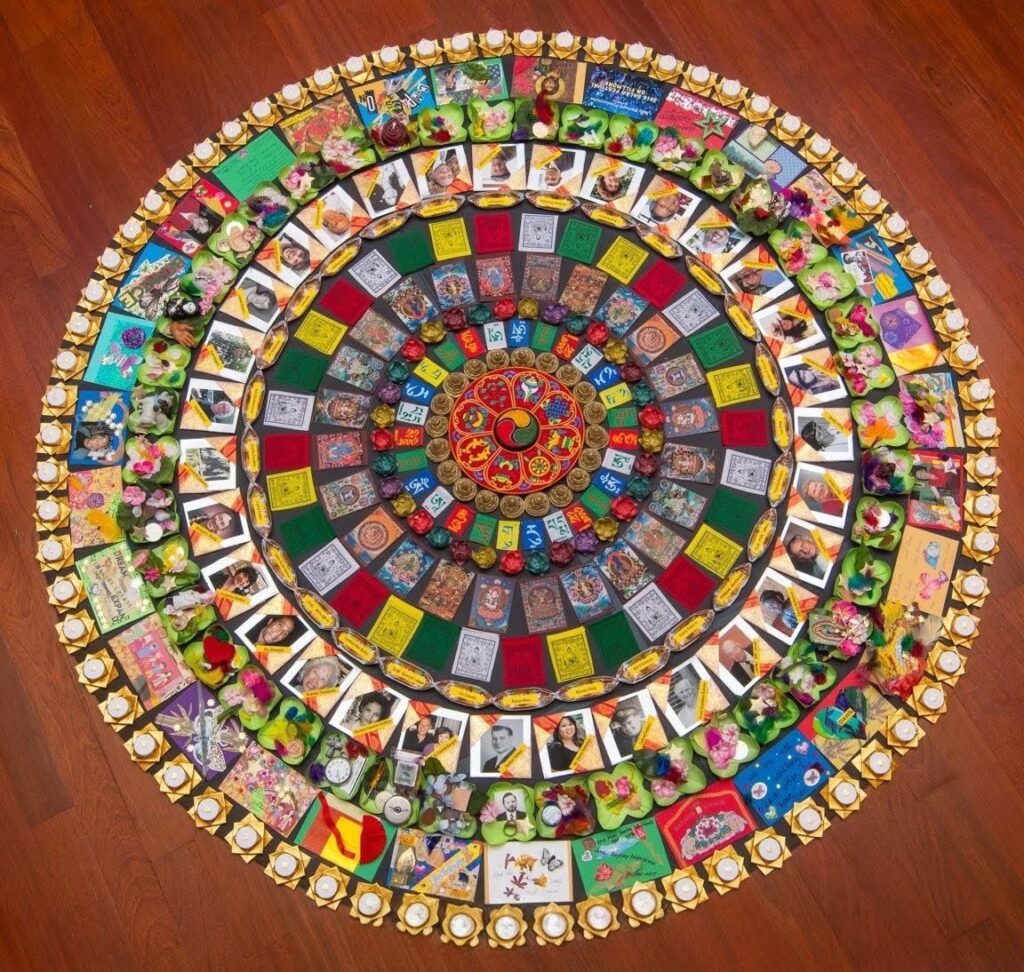
It was time for snacks and the closing of the event. I encouraged everyone to take a break, but no one walked away from the circle. They told stories of their loved ones, and they listened to others’ stories. They stood there for a long time with arms entwined, gazing at the flickering tea lights. By grieving together, they saw that they were not alone in their sorrow. The burden had lifted for some, and in their own way, everyone understood a little better the upaya (skillful means) of the Buddha and the mustard seed tale.
Contemplative Exercise
A grief mandala is a skillful way to process the loss of a loved one. Here are step-by-step instructions for creating a small grief mandala with others to honor the memory of eleven people. The size of the circle and the number of honorees is not fixed. You should feel free to adapt these guidelines for a personal experience.
֎ Make a round black base that’s roughly sixteen inches in diameter. Use a template (for example, a pizza pan, cake round, wreath form, or hoop) to trace a circle onto a slightly bigger piece of black construction paper. I used a dart board as the template for the sample pictured here. Cut out the circle. Alternatively, you can buy a black cardboard circle from a craft store (or use a different color if you prefer).
֎ Find a picture of Amitabha, an endless knot, a lotus, or another meaningful image that’s four or five inches in diameter. Use an old CD or a small plate to trace a circle over the image and then cut it out. For support, attach the image on top of the CD with double-sided tape or paste it onto a round piece of cardboard. Place this image in the middle of the mandala on top of a slightly raised platform. I used a jar lid this time, but you can use stacked coasters, a small dish, or something else that’s small, round, and about one inch high. It won’t be seen.
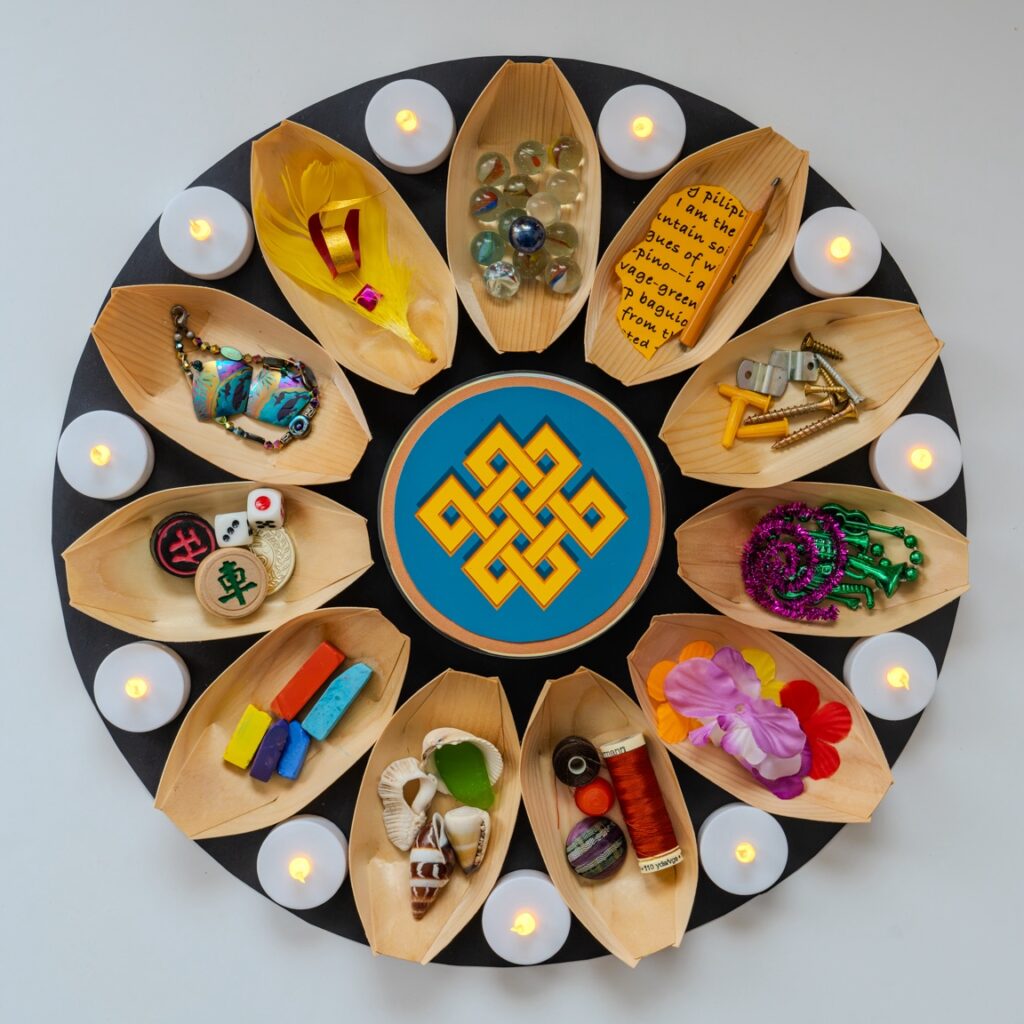
֎ If you are making a mandala this size, you’ll need to prepare eleven tea light candles. If your circle is a different size, prepare enough candles to fill the perimeter.
֎ Invite friends to co-create this little mandala for those who have died. For the gathering, each person should bring a few small objects that evoke the memory of their deceased loved one: jewelry, shells, small photos, charms, marbles, dice, beads, candy, a slip of paper with their name, and so on.
֎ Make origami boats, buy bamboo appetizer boats, or use other similar items as vessels. For this sample mandala, I used bamboo boats that are two and a half inches wide and five inches long. Each person puts their mementos in one of the vessels and then places it so they radiate from the middle like flower petals.
֎ After everyone has filled a boat and added it to the mandala, each participant then lights a candle, says their deceased person’s name out loud, and places it in a space between the boats in the mandala. Once you become comfortable with creating small mandalas, you can start with a bigger circular base and add more concentric rows around the middle to include more people and more offerings.
֎ After the candles are lit, gather around the mandala and contemplate for a few minutes. Life is impermanent, and death happens to us all. People can share more about the person they are honoring, if they wish.
֎ Recite a sukhavati prayer or express your wishes for the deceased. Feel the mutual support and empathy from everyone in the room. Rest in that energy and know you are not alone in your grief. Dedicate the merit by wishing that all beings be free from suffering.
A Note from the Editor: We know how creative and compassionate our readers are, and we’d love to see your artwork. Following the Tara Drupchen and in this month leading up to Dia de Los Muertos (Day of the Dead), if you make a grief mandala on your own or with friends and are willing to share the images, please send your photos to silkNblaze@gmail.com. We’d love to do a follow-up article with your beautiful, heartfelt mandalas.

Nancy Hom is an artist, writer, curator, community organizer, and Nalandabodhi sangha member based in San Francisco. Her work over the past 50 years has focused on passionate engagement through artistic projects as she seeks to empower and connect people through art and leadership. Through her posters, poetry, illustrations, installations, and curatorial work, she uses the arts to affirm the histories, struggles, and contributions of diverse communities. Since 2012, she has created over 26 large-scale mandalas that offer reflections on change, interdependence, and common purpose. nancyhomarts.com