
Skillful Means
Some Thoughts on Protection
Arising from the mandala of suffocating black wind at a kalpa’s end,
Mistress of a host of activities and pristine awareness
Leader of the mamos, Great Queen of the World;
Homage to the Lady of Mantra, Ekajati!
—Nyingma liturgical verse
As vajrayana Buddhists, we chant liturgies supplicating protectors for support as we prepare for a new year and at other times. We ask them to witness our past mistakes and we pledge our commitment to making a fresh start.
But what are we actually doing?
Are these protectors protecting us and improving our lives as we ask them for longevity, good health, freedom from illness, and good fortune? Or are we asking them to protect the living dharma, the truth of the way things are? Or do we invoke them to protect the teachings about the dharma, the sutras, the tantras, the ocean of scriptures?
Or all of the above?
A Protection Cord Story
When I was a very new Buddhist way back in the Dark Ages, I saw many people with “protection cords”—red strings—around their necks. Some people were wearing quite a few. So I asked my meditation instructor, who seemed to know a lot, what these cords were supposed to be protecting us from. Evil? I don’t remember if he laughed, but he said, “No, no. These cords are protecting the dharma from you.”
I have often thought about his answer over the years. What do we do that might endanger the dharma? How can the protectors protect me? And what am I needing protection from? Let’s examine some of these things. I made a little list for myself. Feel free to add to it.
Things to Protect the Dharma From
~ Arrogance, self-importance, and ideas of independence. “I don’t need any help.”
~ Self-doubt and insecurity. “I’m not good enough.” “I’m not a good practitioner.”
~ Sophisticated cynicism, that is, our negative attitudes toward what we don’t know, and doubt in the dharma. “I’m not sure I buy into all of this.” “Maybe Pilates would be more helpful.”
~ Trivializing, belittling, gossiping, judging, pettiness. “Yeah, sounds good on paper, but . . .”
~ Stinginess. “I already gave this year.” “I need my money for my retirement.”
~ Habits of over-intellectualizing and over-opinioning. “I disagree with the word devotion; maybe conviction or respect would be better.” “I’ve been studying emptiness for thirty years, so I think I know what I’m talking about.”
~ Laziness. “I’m too tired to practice.” “I have too much to do.” “I’ll practice on the weekend.”
~ Making the sangha into a social club. “Let’s get together for lunch and talk about mindfulness.”
~ What else?
What Do I Need Protection From?
The most obvious answer is I need to protect my mind from myself, my ego, my self-cherishing, the “I come first” habit, and all the many ways we twist things trying to protect this little “me.”
There are two root thought habits that seem to cause the most damage: dualism and fear. In The Aspiration of Samantabhadra, the first buddha says, “Dualism is doubt.” We clever sentient beings invented a separation between ourselves and others. There’s a “me” over here, and you all are over there. And because we are separate, I need to protect “me” from “you.” This is the basic issue. However, it’s a shaky situation—because it isn’t actually true. We know better. We know that the feelings of being real, truly existent, and separate are a hoax. We make a strong defense for our selfness, but we’re bluffing. We have doubt about it all. And then, because we doubt, we are afraid. Raw fear. We fear accepting, acknowledging, appreciating, and nourishing our buddha nature, our bodhicitta heart. The true emptiness of self. We avoid the hard, remedial work that acceptance would mean. We even avoid the hard work of acceptance. We like our mythology.
We need help on the path of liberation from samsara, so we call upon the protectors. But if we aren’t clear about what we need protection from, or how incredibly precious the dharma is, or how harmful to it our ignorance is, the protectors cannot help. What or whom are we calling upon?
Ekajati
Colorado sangha member Meg Miller suggested that I talk about Ekajati as an example of a protector called upon often by vajrayanists. I didn’t know much about her, nor am I a scholar, so I turned to Google, Wikipedia, and a book by Judith Simmer-Brown called Dakini’s Warm Breath. If this information is incorrect or incomplete, I hope it will at least outline a picture of this powerful protector from the Tibetan tradition. Even more, I hope it will bring her closer to us.
Namkhai Norbu called Ekajati “a personification of the essential nondual nature of primordial energy; she does not allow duality to develop.” Just what we need! Here are some details about Ekajati.
Ekajati’s History
Ekajati can be found in both Indian Hindu traditions and Tibetan Buddhist traditions. Some sources say she originated in Tibet and was imported to India.
She might have been introduced into Nalanda University by Nagarjuna.
She is a protector deity for both the old and the new translation schools.
She is said to be an emanation of Akshobhya, wisdom buddha of the vajra family.
Primarily we know her from the Nyingma tradition as the protector of the terma or “revealed treasure” tradition.
Ekajati’s Uniqueness
Ekajati is the only female protector.
She is known as the queen or chief of the mamos—the female controllers of many forms of negative energy, such as wars and famines.
She is one of the two companions of Khadiravanitara. She stands on Tara’s left side, and Marici stands on Tara’s right.
One source describes her as a patron deity, responsible for assisting all great female practitioners.
She is the principal guardian of the Dzogchen teachings, protecting the secrecy and preciousness of the texts and mantras of Dzogchen.
She embodies uncompromising nondualism.
Ekajati’s Appearance
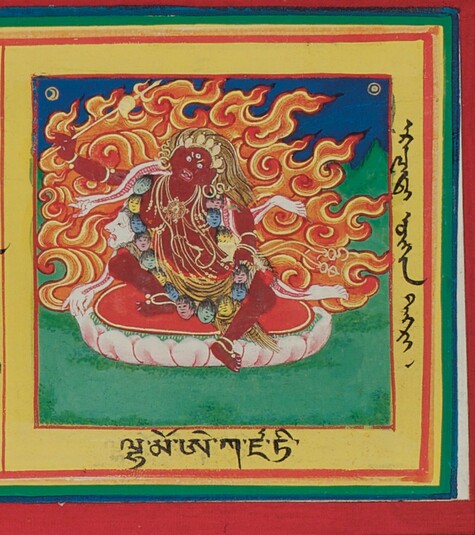
Ekajati is commonly pictured as semi-wrathful, naked except for a tiger skin around her waist and clouds around her shoulders, with one face and two arms.
She is surrounded by wisdom flames.
She often has a single eye in the middle of her forehead, one triangular tooth in the middle of her upper jaw, one large breast, and one braid, tuft, or topknot of hair.
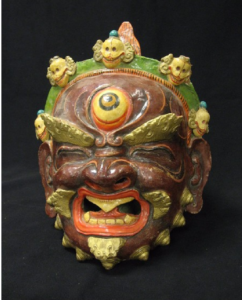
~ One eye means she has all-encompassing vision. She sees the past, present, and future.
~ Her one tooth, shaped like a phurba, precisely cuts attachment, ignorance, and enemies of the dharma.
~ Her one breast signifies that she is swift in nurturing and bestowing accomplishments on practitioners.
~ The name Ekajati means “one braid” or “one bunch” (eka = one, jati = tuft or braid). Her single braid of hair symbolizes emptiness, the ultimate nature of all phenomena. Namkhai Norbu translates her name as One Single Birth.
~ In Dakini’s Warm Breath, Judith Simmer-Brown says, ”She speaks in sharp, piercing shrieks, her eye boils, and she gnashes her fang.”
Ekajati is also pictured in several other forms. She can have up to twelve heads and twenty-four arms.
Sometimes she is shown as dark red or brown, like a dried blood color, but generally she is depicted as having a dark blue or blue-black body.
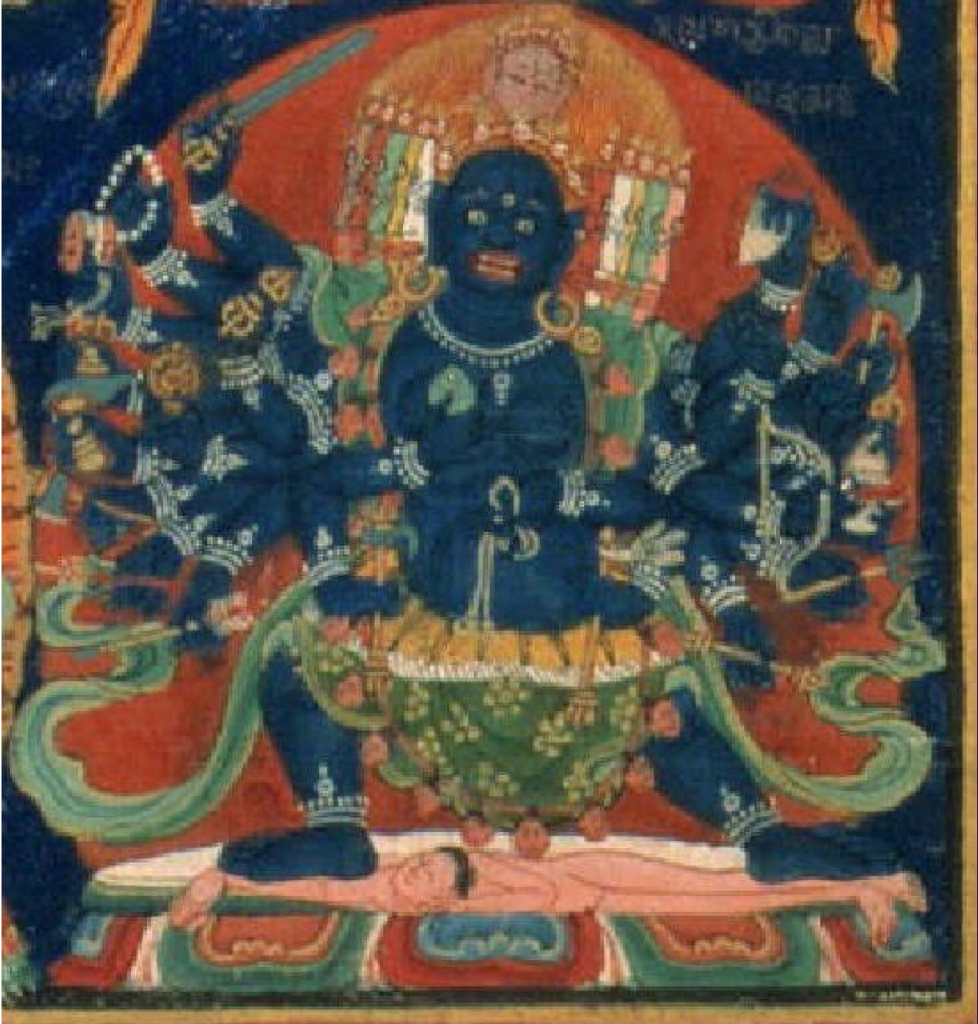
She wears a garland of human heads or skulls, and sometimes she is ornamented with snakes.
Once in a while, she appears standing on a single leg. Sometimes she is in the dancing posture. However, mostly she stands on two legs, with both feet stomping on a corpse of a perverter of the teachings (rudra or ego).
When she laughs, her vajra laugh reveals a split or forked tongue.
She holds a bloody red heart in one of her hands (sometimes right, sometimes left). It is the heart of those who have broken their vajrayana vows.
She emanates a hundred iron she-wolves from her left hand.
Sometimes, she holds a skull cup.
Her implements vary, as do the postures of her legs.

Working with Ekajati as Upaya
As a protector, Ekajati is an “arrow of awareness” for practitioners who are discouraged or lazy. We supplicate her to remove our fear of the enemies of our progress toward liberation and to remove any personal hindrances and adventitious stains on our path to enlightenment. We ask for her one-pointedness, her swift and uncompromising nature of enlightened wisdom, to help us destroy ego, obstacles, and delusions and help us spread joy.
With Ekajati’s support, we can protect our own mind and the dharma by committing to cultivating our basic buddha nature, by seeing obstacles as opportunities, by growing our confidence, devotion, and kindheartedness, by manifesting our bodhicitta heart toward all with equanimity, by being grateful to everyone, by getting and staying in touch with our power, and by waking ourselves up.
But also we need to keep things simple, remain humble, and accept things as they are. Chögyam Trungpa Rinpoche said, “Humbleness is the dwelling place of the forefathers” (or foremothers or, as our guru Ponlop Rinpoche says, our forebears/four bears).
We also protect the dharma by working to be open, spacious, and relaxed and by holding the view. We understand the inseparability of our guru and the protectors. We trust and practice the six paramitas as the protectors of the precious dharma while remembering the nondual oneness of everything. Ekajati is who we are!
As practitioners, we can examine ourselves regularly as to what needs to be discarded and what needs to be protected. Rinpoche has said: “Appreciate your neurotic mind first. Then develop kindness to sentient beings.” Working with our protectors, including Ekajati, is a skillful method we can develop so that we can be of most benefit in the world.
Contemplative Exercise
In our confusion and ignorance, we allow the fictitious ego to undermine the dharma by disguising our self-cherishing neuroses as virtue. To counteract that, I suggest contemplating the mind-training slogan “Avoid the six misunderstandings.” This is number 52 of the 59 slogans and is also translated as “Don’t misinterpret.” We can use this skillful method to examine the ways we can protect both the dharma and our progress on the path.
- Find a picture or a thangka of Ekajati. There are some good ones included in this article, and there are many others online.
- Settle into a good upright posture in front of her.
- Sit with her for about five minutes, reflecting on her powerful qualities of nondual wisdom and sharp awareness.
- Then bring to mind, in turn, each of these six errors of understanding from slogan 52:
Patience. Being patient with things like traffic, electrical outages, or your puppy but not with your daily dharma practice.
Desire. Wishing for a relationship or a new car but not for liberation from samsara.
Pleasure. Being excited to attend a football game or dinner party but not a teaching or retreat.
Compassion. Feeling concern for your dharma siblings but not for the unhoused person on the street corner.
Priorities. Making time for nature walks and shopping but not for meditation practice.
Joy. Having gladness Being glad about your enemy’s suffering but not about the attainments of other dharma practitioners.
- Conclude by resting with Ekajati, allowing her presence to manifest in you.
- Dedicate yourself to bringing joy to the entire world.
Mitra Lee Worley, professor emerita and a founding faculty member of Naropa University, became a student of Chögyam Trungpa Rinpoche in 1974. At Naropa, she developed the undergraduate program in theater studies and co-created a low-residency master’s program in contemplative education, among many other initiatives over four decades. Mitra Lee earned a master’s degree in Buddhist studies/Tibetan language through Naropa, and in 2005, Dzogchen Ponlop Rinpoche appointed her as one of Nalandabodhi’s four senior western teachers, known as mitras (from the Sanskrit word kalyanamitra, which means “spiritual friend”). Her two books, Coming from Nothing: The Sacred Art of Acting and Teaching Presence: Field Notes for Players, present topics and exercises from her contemplative performance and embodied teaching techniques. Mitra Lee currently studies and teaches within Nalandabodhi International, and she also offers workshops based on the Space Awareness teachings of Chogyam Trungpa, which she has been practicing since 1975.